
There are nursery corners we walk past every single day and still stop to look at. They weren’t set up for a photo and nobody designed them: they came together on their own, plant by plant, until one day you notice that stretch of aisle has turned beautiful.
A jumble of shapes and colours that somehow works
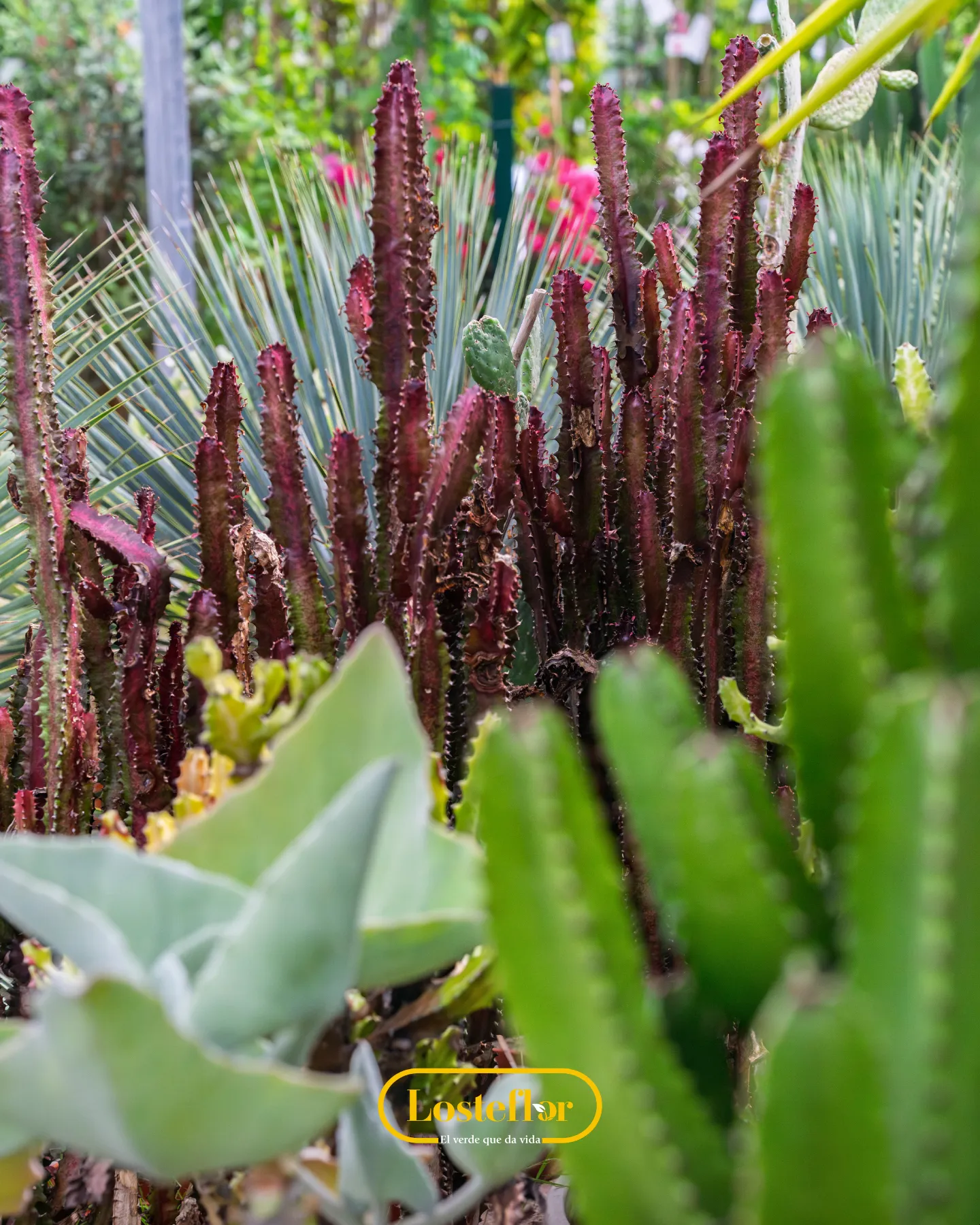
The scene that opens this post is one of those nursery corners. Columnar stems in a deep burgundy, with a toothed edge, growing tightly packed upwards. Behind them, fans of stiff, bluish leaves that look like needles. In front, green silhouettes with a desert feel and fleshy leaves in an almost matte grey-green. And at the back, out of focus, a splash of pink flower that nobody put there on purpose.
None of it is planned as a composition. It’s simply how the work of a nursery organises itself: whatever shares the same needs ends up together, and the result has more charm than any staged set-up. That’s why the nursery corners change without us doing anything special, just from the way the plants move and grow.
It’s also what makes a walk around here nothing like reading a product sheet. There’s contrast in the textures, heights that don’t line up, a colour that shows up where you least expect it. That mix, repeated all over the nursery corners, is what gives you ideas for your own terrace or garden.
Passiflora caerulea, the jewel of the nursery corners
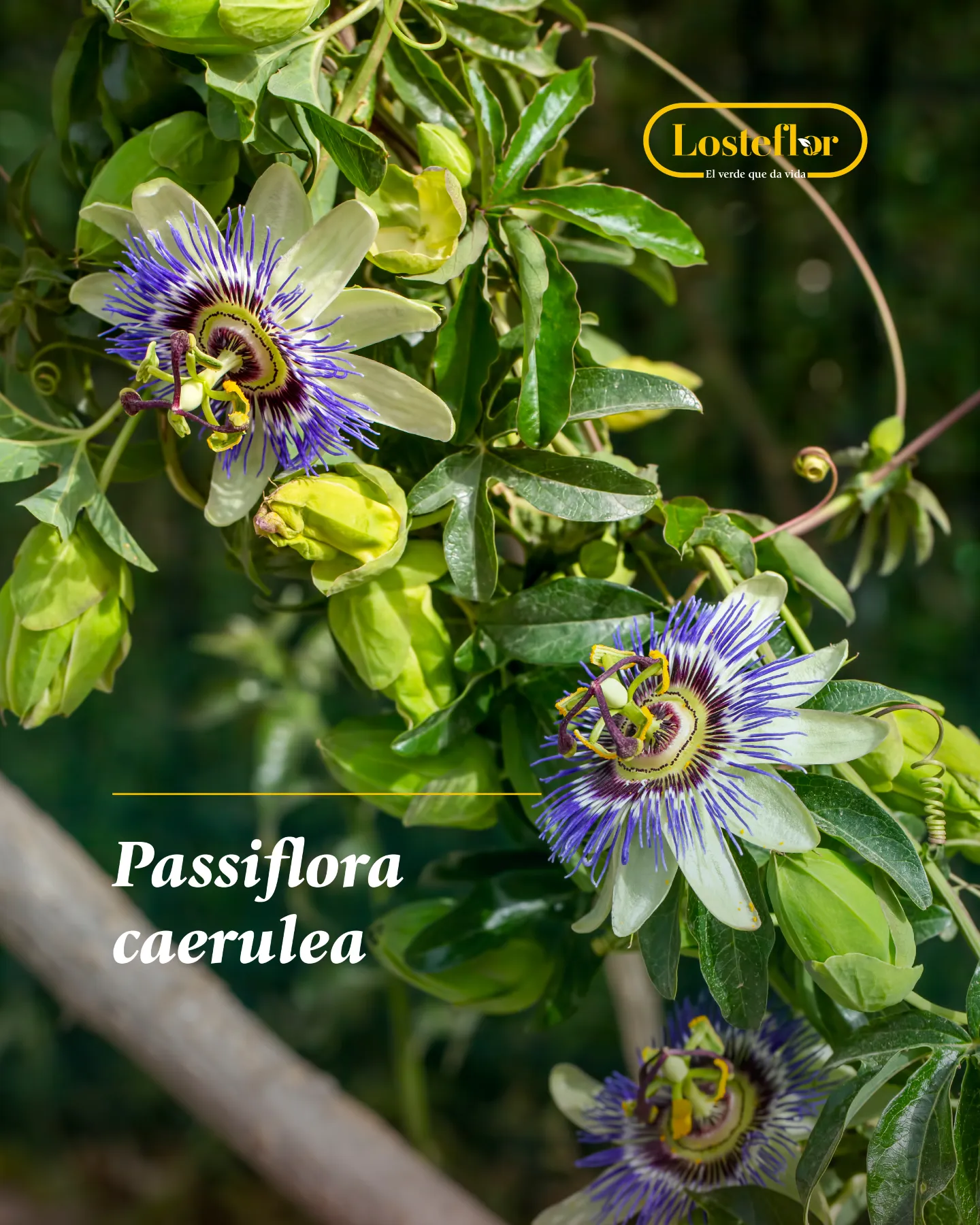
If there’s one plant that stops people in their tracks, it’s this one. Passiflora caerulea, the classic passion flower, has a bloom that’s hard to believe is real: a crown of very fine filaments in blue and purple over creamy white petals, and in the centre a structure that looks like it was drawn with a ruler and compass.
In the photo you can see it climbing, gripping with those spiral tendrils of its own, with green buds waiting their turn all around. Impossible geometric shapes, vivid colours and an elegance that turns any outdoor corner into a jewel. It’s here at the nursery, and seeing it up close is another story altogether. If you’re drawn to flowers that can take the sun down here, take a look as well at our selection of sun-resistant flowering plants.
How to walk the nursery corners without missing a thing
Our advice is simple: come with a photo of the spot you want to fill. The living room, the corner of the terrace, the wall that has been asking for something for years. With that photo in front of you it’s far easier to decide, because you’re no longer choosing a pretty plant in the abstract, you’re choosing the plant for that particular gap.
Then walk slowly. The nursery corners reward anyone who looks twice: there are small specimens hidden underneath the big ones and combinations you only spot when you crouch down a little. And if something catches your eye and you don’t even know its name, just ask. That’s what we’re here for.
Seeing them in person changes the decision
A photo shows you the colour. It doesn’t show you the real habit, or how that plant looks next to the one you already have at home, or the size it will be in two years. That’s why we insist so much on taking the walk: the nursery corners work as a living catalogue, and ten minutes between the aisles settles doubts that messages never do.
We’re in Chiclana de la Frontera, Cádiz. Bring your question with you, that’s what the team is for.
Frequently asked questions
Where is the Losteflor nursery?
In Chiclana de la Frontera, Cádiz. You can open the location on the map with the button above and come and walk the nursery corners whenever you like.
Does Passiflora caerulea climb on its own?
In the picture you can see it holding on with its tendrils, which is how it naturally grabs whatever is around it. If you want it for a trellis, a wall or a pergola, ask us at the nursery and we’ll tell you how we keep it.
How do I know whether you have a particular plant before coming over?
Ask us through the contact form and we’ll tell you if we have it. That way you can use the walk around the nursery corners to discover everything else.